A price on its own has nothing to be measured against
A tech gives one number and the customer says he needs to think about it. Before calling it a price objection, check what he had to compare.
A tech writes one number on the page and hands it over.
The customer looks at it for a second and says he needs to think about it.
It is tempting to file that under price. He thought it was too much. We are too expensive. Maybe we should come down.
But that sentence does not tell you why he stopped. It could be price. It could be timing, trust, or something he has not understood yet.
Before changing the number, I would check what he had to compare.
What a single number leaves out
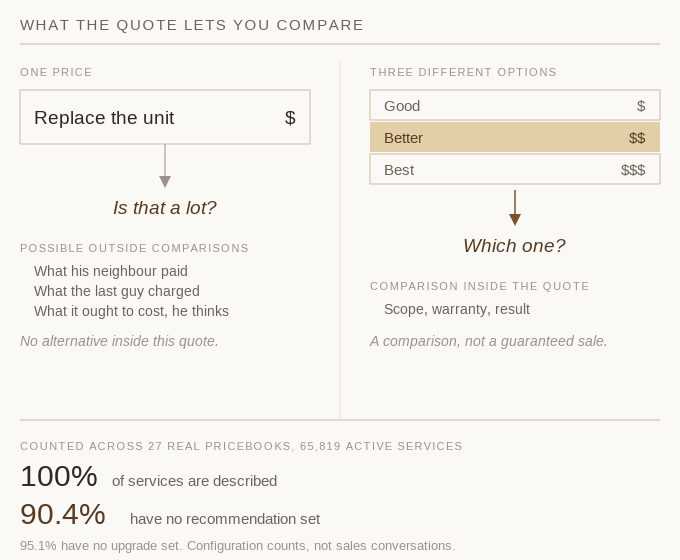
Put one price in front of somebody and he can ask whether that is a lot. Your quote gives him no second option to measure it against.
He might reach for what his neighbour paid. What the last guy charged. What he feels a thing like this ought to cost. Those comparisons may not cover the same work.
Now put three genuinely different options in front of him. Explain what changes between them and what each one solves.
He can still say they are too expensive. But he can also compare the work, the warranty and the result without having to find another quote first.
That is the useful part. Not three numbers for the sake of three numbers. Something meaningful to compare.
What the count actually tells us
I went through 27 real pricebooks, 65,819 active services, and counted.
Every one of those services had a description.
90.4% of them had no recommendation set. 95.1% had no upgrade set. In 13 of the 27 books there was not one recommendation anywhere in the entire book.
The full count, the method, and how it was de-duplicated are published as the census, and you are welcome to cite it.
Those are counts of fields in the books. They are not counts of what technicians offered or why customers said no.
A tech could still put options together manually or present them another way. An empty recommendation field does not prove that the customer saw only one price.
My concern is what has been prepared before the visit. If alternatives are not set up in those fields, I would check where they are prepared instead. Maybe there is a clear process elsewhere. Maybe each tech is left to work it out on the job. The export alone cannot answer that.
Preparation and presentation are different things
A description tells you what the service is. It does not tell you what else the customer could choose.
That is why I would look at the book and a few actual quotes together. What was ready before the visit? What reached the customer? Were the differences explained?
Having three is only part of it. Whether those three actually offer something different is a separate problem, and it has its own piece: best is a label, not a check.
None of this needs software
A paper quote can show one option or several. So can a tablet.
The question is not which screen the tech used. It is whether the customer was given a clear comparison of work that fits the job.
What to do with this
Open your book and check which services have alternatives prepared. Then look at a few recent quotes for those services.
If the fields are empty, find out how options reach the customer instead. If the quotes show one price, ask why. Sometimes one solution is the right recommendation.
But do not lower a price just because somebody said he needed to think. First find out what he needed to understand.
Every one of these is something I watched happen in a real book. The principle above is what they add up to.