Best is a label, not a check
A technician opens a service and the screen offers him a better version that costs half as much. Nothing in the system noticed, because nothing in the system was looking.
A technician opens a service priced at twenty four thousand four hundred and forty dollars.
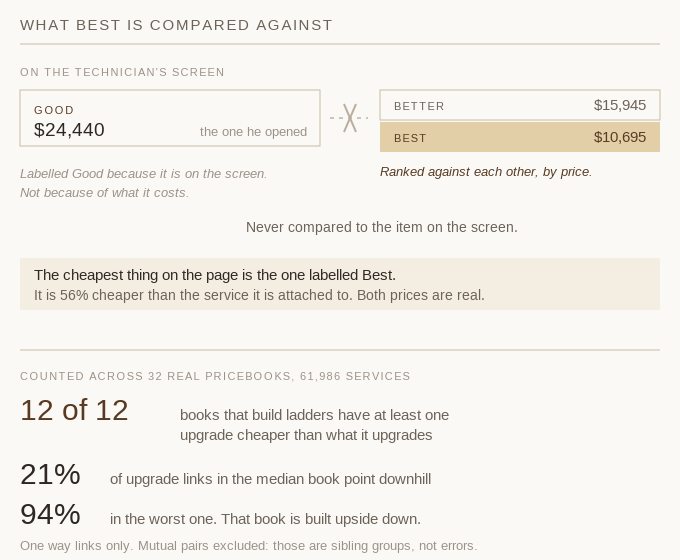
The screen offers him the upgrade. The upgrade costs ten thousand six hundred and ninety five.
That is a real pair out of a real book. The expensive one is labelled Good. The cheap one is labelled Best.
Nothing is lying. Nothing is checking either.
Here is how the labels get assigned, from ServiceTitan’s own documentation on upgrades. The item the technician is looking at is labelled Good. The items attached to it as upgrades get labelled Better and Best, ordered from lowest to highest price among themselves.
Read that again and find the hole.
The upgrades are compared to each other. Not one of them is ever compared to the item being upgraded. And the item being upgraded is labelled Good whatever it costs, because it is the one on the screen, and that is the only reason.
So best does not mean better than what you are holding. It means last in a short list.
How often this happens
I counted it across 32 real ServiceTitan pricebooks, 61,986 services, one book per account. This is a separate count from the census, which ran on 27 accounts and asked a different question, so the totals are not meant to line up with it.
Fourteen of those books use the upgrade field at all. Every single one of the twelve where the prices can be compared has at least one upgrade that costs less than the thing it upgrades from. Twelve out of twelve.
The usual rate is about one in five. The median book has 21% of its one way upgrade links pointing downhill. Outside the worst book there are 432 of these pairs, and the typical one is 25% cheaper than the thing it is supposed to improve on.
One book in the sample runs backwards almost entirely. 94% of its links. That is not a few bad rows. That is a ladder built upside down, shipping every day, and nobody in that shop knows.
One number I am not going to give you, because it is the one that sounds best. Add every book together and you get 63%. That figure is true arithmetic and a false impression, because the one backwards book contributes most of the bad links by itself. The honest numbers are twelve out of twelve, and a median of one in five.
What I threw out, and why it matters
In about a quarter of the links, two services point at each other. A lists B as an upgrade and B lists A right back.
Those are not mistakes. That is a shop putting the whole group on every member so a technician sees the full ladder no matter which rung he opens first. One of those two directions has to point downhill by arithmetic. Counting them as errors would have doubled my number and been wrong.
I also expected to find upgrades pointing at items that had been deleted or switched off. There were none. Not one, out of seven and a half thousand. Whatever else is loose in these books, that field holds its references.
Price is only the half you can count
A ladder can climb in money and go downhill in everything else.
I was in a book for something unrelated and read down a two and a half ton install comparison by specification instead of by price. The third option cost the most and carried a lower efficiency unit than the second. Everything the customer could see went up. The thing he was buying went down at the last step. It had been live for months.
Efficiency is not a column in a pricebook export, so I cannot tell you how often that happens. I can only tell you it happens, and that the half I can count is already failing in every book that tries.
Software did not cause this
A printed option sheet does the same thing. Three boxes down the page, the bottom one in bold, the word Premium under it. The paper does not check either. It just holds whatever was typed into it in whatever order.
The software only makes the label look official, and it repeats the mistake on every job instead of one.
What to do with this
Open your three most quoted comparisons. Read them twice.
First by price. If anything you labelled better costs less than the thing it is attached to, a customer has already been shown that.
Then by specification. Efficiency, comfort features, warranty, scope. Read down the columns and check what the extra money buys. Capacity is different. It has to fit the calculated load, not climb with the price. A bigger unit is not automatically a better one.
A system will tell you which option is last in the list. It will never tell you which one is better. That part is still yours.
Every one of these is something I watched happen in a real book. The principle above is what they add up to.